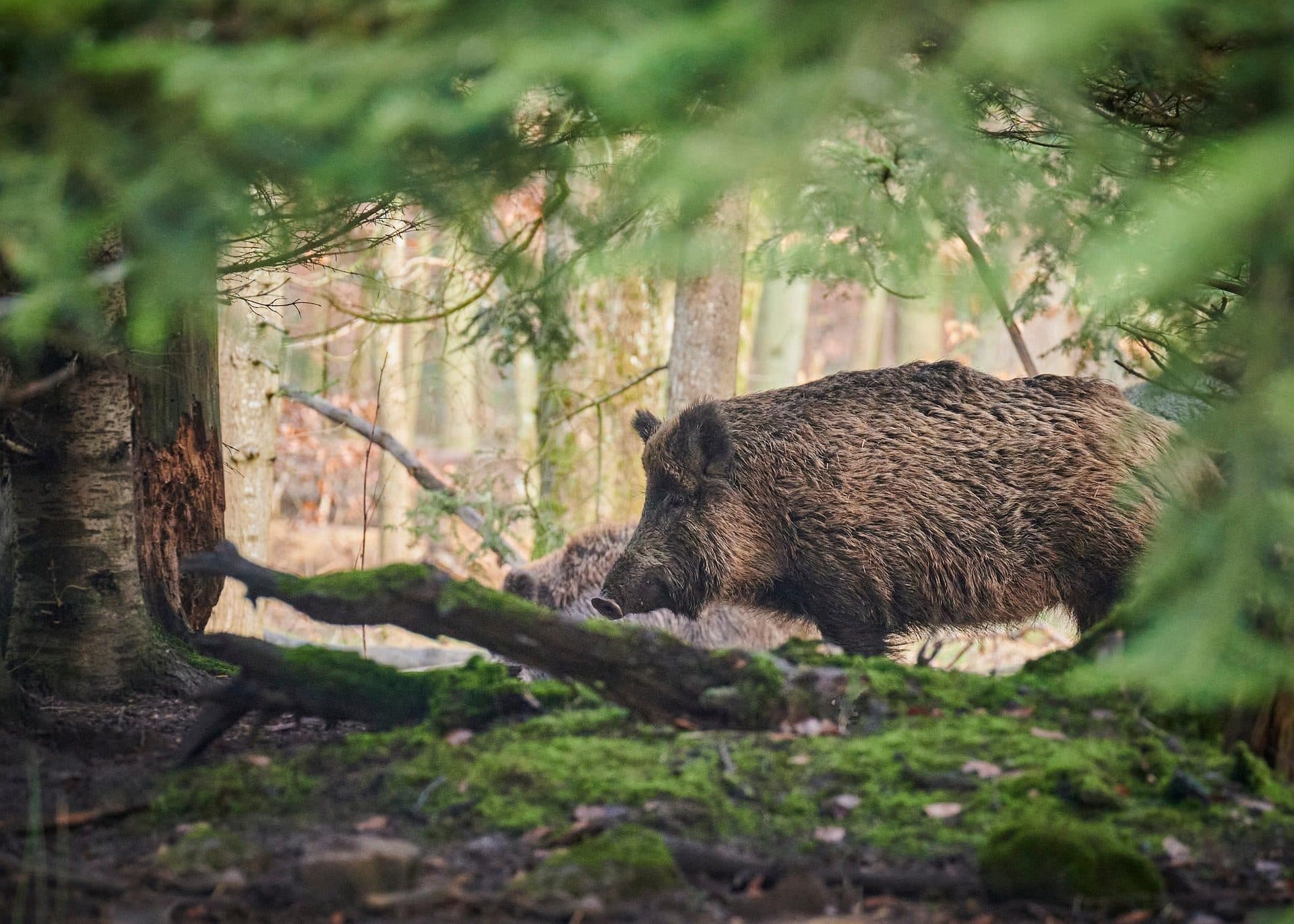
Wild Boar in Winter: The Rut, the Sounder and What It Means for Your Hunting
Spend a few evenings in a high seat in November or December and you will notice it: wild boar behave differently at this time of year. Mature boars that have been invisible for months suddenly turn up with the sounders. Trails that saw little use in summer are freshly rooted up overnight. None of that is chance. Winter is the busiest season in a wild boar's year. Most of the rut falls in these months, and at the same time the animals have to find enough food to get through the cold. This article explains what goes on inside a sounder, how to read it in the field, and how to hunt responsibly around it.
How a sounder is organised
At its core, a sounder is a family group of sows and their young. It is usually led by the oldest and most experienced sow, the lead sow (in German, the Leitbache). She knows the safe trails, the best feeding spots and the quiet beds, and the rest of the group follows her decisions. Around her you will find younger sows, yearlings from the previous year and the current year's piglets.
For most of the year, mature boars live alone or in small bachelor groups. Only during the rut do they seek out the sounders. A strong boar may then travel with a group for days and drive off younger males.
For hunters, the role of the lead sow matters most. She decides not only where the group goes, but also influences the pace and timing of breeding within it. Remove her and the structure of the sounder breaks down. Younger sows can come into season in an uncoordinated way, the group may split up, and crop damage can actually increase.
What happens during the rut
The rut runs roughly from November to January, with regional differences and exceptions. Food supply plays a big part: in a heavy acorn and beechmast year, sows reach good condition sooner and breeding can start earlier or spread more widely.
Things you are likely to see during this period:
- Boars with the sounder. Mature males appear in the company of sows, sometimes in daylight or at dusk in places you would not expect them.
- More movement. Boars cover long distances between sounders. They cross roads and turn up in areas they rarely visit otherwise.
- Restlessness and fights. Boars that meet can clash hard. Fresh rubbing marks on trees and posts, and occasionally blood or hair on trails, are signs of those contests.
- Less caution. Younger boars in particular seem less wary in these weeks. That makes them easier to observe, but also less predictable.
Signs to look for in the field
After a frosty night or a light dusting of snow there is a lot to read:
- Tracks of mixed sizes together. A group of small and medium tracks with one noticeably larger print that seems to join later often points to a boar that has attached itself to a sounder.
- Rubbing trees. Boar rub against trees after wallowing. In the rut you will often find fresh mud higher up the trunk than usual, a sign of a big animal.
- Rooting. In winter, boar root intensively for roots, grubs and mouse nests. Fresh rooting with loose, dark soil is often no more than a night old.
- Beds. In the cold, boar build nests of branches, grass and leaves. A bed like that in thick cover gives away a regular resting place.
What it means for your hunting
Always take time to identify
In winter, yearlings and young sows in their thick coats easily look bigger than they are. Take your time. Look at the proportions within the group, at behaviour, and at which animal is in front. The lead sow often walks first, or stops to check the surroundings before the rest follow. If in doubt, don't shoot.
Young before old
A widely used rule of thumb in boar management is "young before old": take piglets and yearlings first and spare the lead sow for as long as possible. This keeps the structure of the sounder intact and helps to control population growth. When shooting from a sounder, the sensible choice is the youngest animal.
Respect the protection of parent animals
In Germany, the federal hunting law protects parent animals that are needed to raise their young (known as Muttertierschutz). In the Netherlands and Flanders there are also rules on when and where wild boar may be hunted or culled, and these differ by province or region. In the Netherlands, wild boar management is largely a provincial matter, with big differences between the established boar areas and the rest of the country. Always check the current rules with the relevant provincial or regional authority, or your local wildlife management body, before you go out.
Adapt your high-seat strategy
Because boars roam so much during this period, sitting over an established trail between cover and feeding ground is often more productive than the spot where you always saw boar in summer. Pay extra attention to the wind: boar have an excellent nose, and in frost, scent carries further across open ground. Be prepared to sit longer than you planned. In winter, sounders sometimes only leave cover late in the night.
Driven hunts
On a driven hunt, a sounder can come past your stand at full speed, and that is exactly when the lead sow is hardest to pick out. Agree beforehand which animals may be shot and stick to it. If you cannot tell which animal is in front of you, let it go.
African swine fever remains a concern
African swine fever (ASF) is still present in several European countries. In winter, when boar move around more, staying alert is especially important. If you find a dead wild boar with no obvious cause, do not touch it and report it to the designated authority in your country or region. After hunting, clean your boots, clothing, equipment and vehicle thoroughly, especially if you have hunted abroad. Never bring uninspected game meat or trophies out of affected areas.
Practical tips for cold nights
- Dress for sitting still. Boar hunting often means hours in the cold. Carry an extra layer and put it on only once you are in the seat, so you don't arrive sweaty.
- Use good optics. Bright binoculars and a scope with a good illuminated reticle help in low light. Where thermal imaging is permitted, it can help with identification, but it never replaces careful observation.
- Plan your follow-up. Boar are tough. Know in advance which tracking-dog handler you can call if an animal doesn't drop on the spot.
- Keep notes. Record which sounders you see, how big they are and when boars appear. After a few seasons that adds up to real knowledge of your ground.
Final thoughts
For anyone who hunts or manages wild boar, the winter months may be the most interesting time of the year. If you understand how a sounder works, respect the role of the lead sow and take your time over identification, you will hunt not only more effectively but also more responsibly. Seen something remarkable from your high seat this winter? Share it in the Hunters Club community.
